How does a written rule compare with a trained model?
In Tooth Detective, students sort forty fossil teeth by hand, with a key and with a model, then compare the three approaches.
Explore the investigation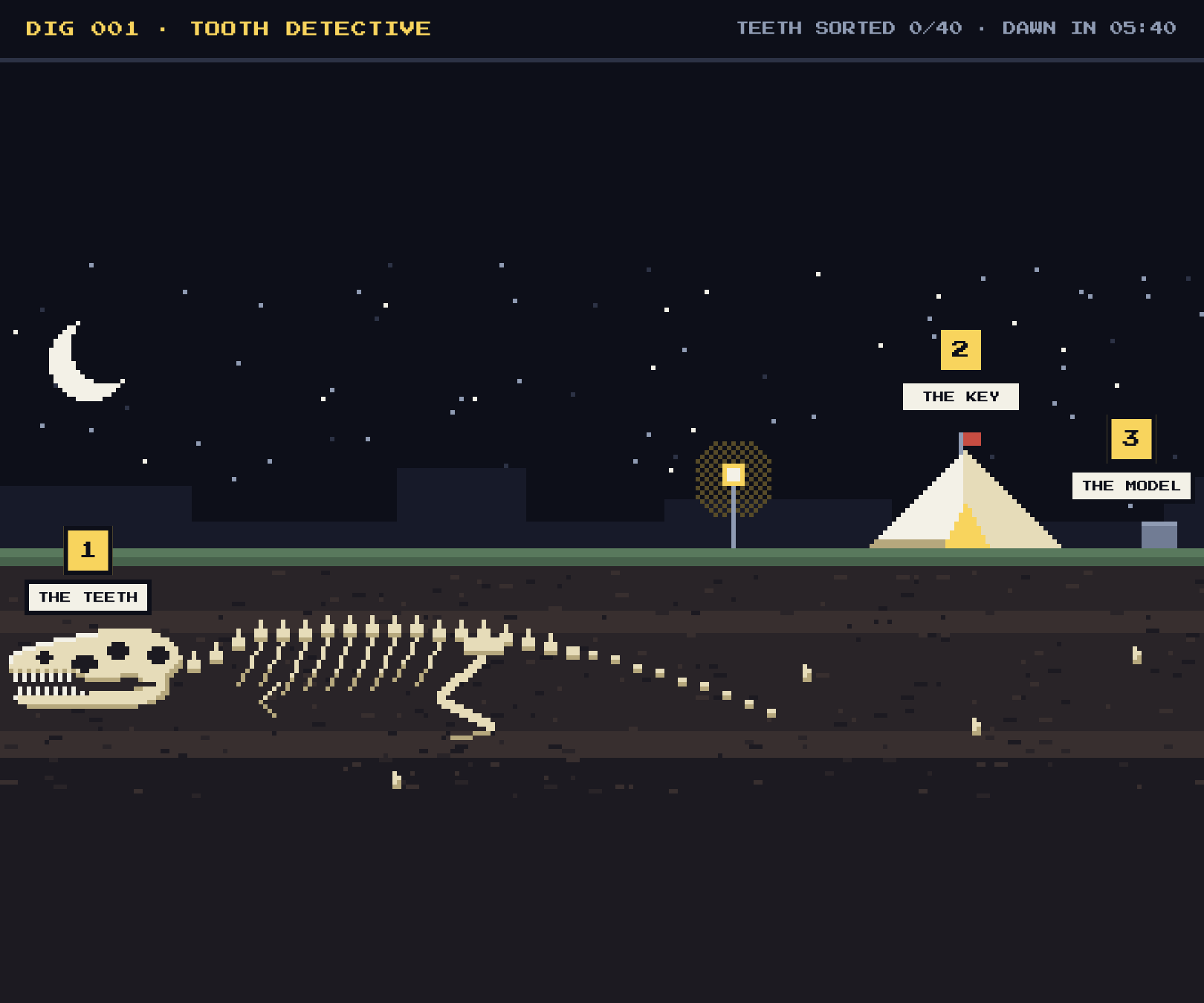
One collection. Three approaches.
Classification means assigning something to a category. Tooth Detective makes that idea concrete with a collection of forty fossil teeth. Students compare sorting by hand, using a classification key and using a model.
The learning question is broader than which approach gets an answer: what is each decision based on, and what would make the comparison fair?
Rules are written. Models learn patterns.
Classification
A classification problem asks which category an example belongs to. Students need to distinguish the category from the features they use to make that choice.
A classification key
A person writes the rules that guide a choice. The key applies those rules; it does not learn new ones from the examples it sees.
A trained model
A model learns patterns from examples. Its output is a prediction to investigate, rather than proof that the classification is correct.
What makes a comparison fair?
A fair comparison needs a common task and a consistent way to judge the results. Agreement between two approaches can be useful evidence, but agreement alone does not establish that either one is correct.
Looking at disagreements helps students explain what each approach can and cannot establish. A reasoned judgement should refer to the examples and acknowledge what remains uncertain.
Ask for reasons, not just a category.
- What features did you use when sorting by hand?
- How does following a written rule differ from using a trained model?
- What would you keep the same to compare the three approaches fairly?
- What can a disagreement tell you? What further evidence would you need?
These are suggested discussion prompts. They connect the activity to classification, rules and evaluation without requiring a particular answer.
See the activity in the context of your class.
Discuss the lesson materials, the intended year group, prior knowledge, available teaching time and curriculum requirements in a walkthrough. Ask to see how the key and model are used and how the comparison is checked.
For the wider curriculum context, read bringing AI projects into the Australian Curriculum. A topic connection is a starting point for planning; it does not establish that an activity meets a particular content description.
Read how the model-building controls work. The technical guide describes the available capabilities; the activity determines which are used.