What changes when you clean and combine the data?
In The Body Atlas, students bring six unrelated health records together, clean them up and piece them into one picture. Every reading is made up.
Explore the investigation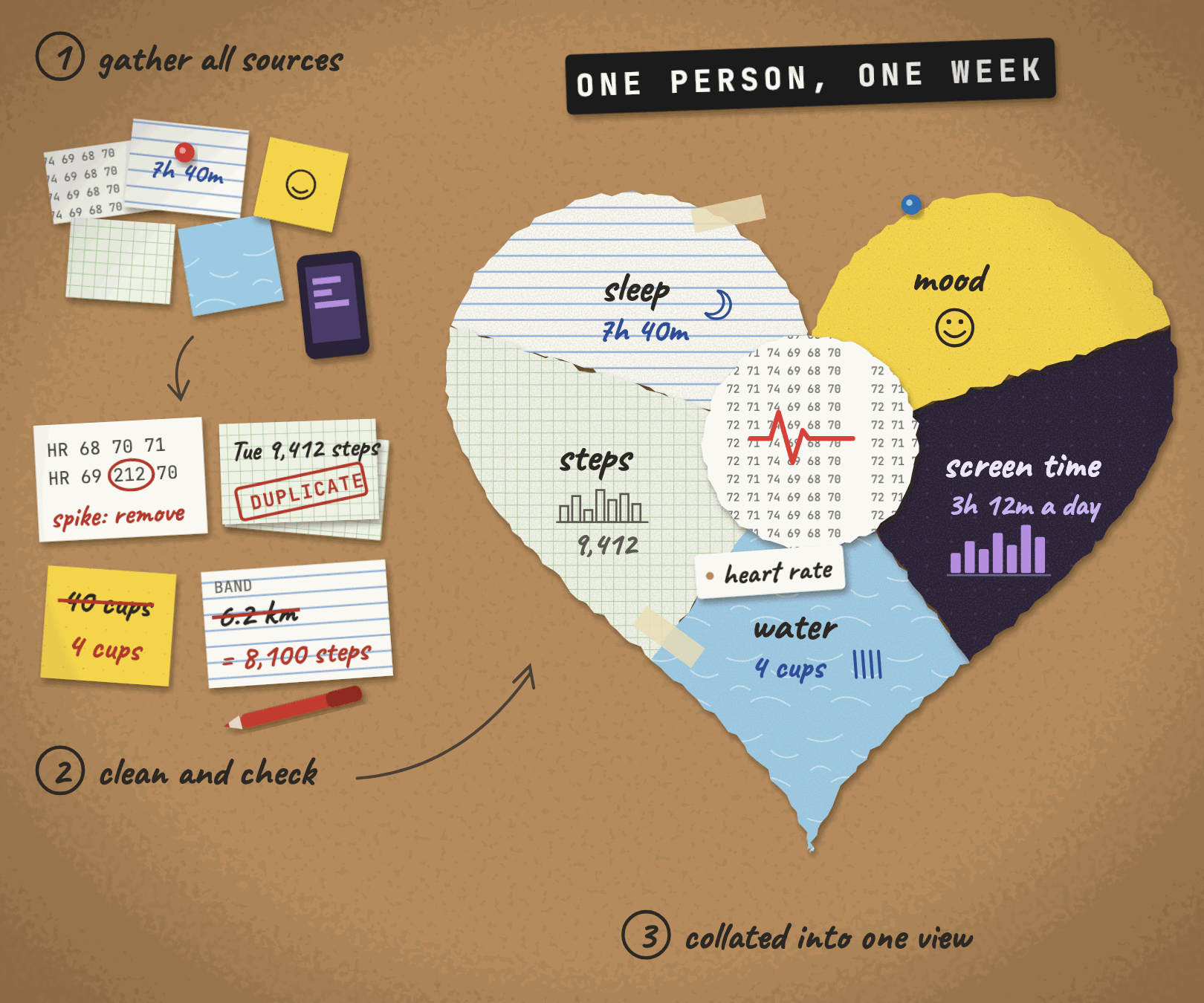
Six sources. One picture.
A record can look convincing on its own and still be difficult to compare with another source. The Body Atlas asks students to investigate what has to happen before unrelated records can be read together.
Students align sources, clean the data and consider what the combined picture shows that no single source can. The emphasis is on the preparation and judgement behind a conclusion.
Data needs preparation before interpretation.
Aligning sources
Before combining records, establish how they relate. Matching records is a decision that needs an explanation, rather than an assumption that everything belongs together.
Cleaning data
Repeated entries, implausible values or inconsistent units can change a conclusion. Cleaning means checking the data and explaining the treatment of a problem.
Interpreting the whole
A combined record can reveal relationships that one source misses. More data also creates more opportunities to draw a conclusion the evidence cannot support.
A model cannot repair an unsupported assumption.
Data preparation is part of understanding a machine-learning system. If records are mismatched or errors are left unexplained, a later prediction may reflect those problems.
The Body Atlas focuses on the data before any conclusion. It gives students a concrete way to discuss the quality of the evidence a model would depend on, without treating every data activity as a model-training exercise.
Make each cleaning decision explainable.
- How can you tell whether two records belong together?
- Which value would you check before using it, and why?
- What changed when you cleaned or combined the records?
- What does the complete picture suggest? What can it still not establish?
These are suggested discussion prompts. Ask students to connect a conclusion to the data and to the decisions made while preparing it.
Fictional readings. Real questions about evidence.
Every reading in The Body Atlas is made up. The activity uses fictional health records to explore data quality and interpretation; it is not a basis for conclusions about a real person's health.
Keep the discussion centred on the supplied fictional records. Students do not need to share their own health readings to discuss the questions on this page.
Connect the investigation to your teaching.
Use a walkthrough to discuss the materials, intended year group, prior knowledge, teaching time and curriculum requirements for your class. Ask to see the records and the cleaning task before planning assessment.
For the wider curriculum context, read bringing AI projects into the Australian Curriculum. Check the relevant content descriptions when planning a unit.
Read how data preparation and recipe replay work. The technical guide describes the available capabilities; the activity determines which are used.