News & Ideas / Our approach
Our approach to teaching AI in schools

Teaching AI in schools involves more than learning to use the latest tools. Writing effective prompts and getting useful answers are valuable skills, but students should also have opportunities to understand how the technology works, question its behaviour and recognise its limitations.
ACARA’s Version 9 AI Curriculum Connection identifies three interrelated aspects of learning: “understanding how AI works,” “types of AI (digital tools and AI systems),” and “responsible use and application of AI.” These connect to data, algorithms, mathematical concepts and system design, including how training data affects an output’s reliability and bias. Chatbot activities can support responsible use and critical evaluation, but prompting alone does not demonstrate an understanding of how data is represented, models are trained or design choices influence their behaviour.
At ML4Schools, we ground these concepts in problems that industries are using AI to solve today. Our custom labs bring those applications into the classroom, putting practical machine learning decision systems in students’ hands. This gives the learning a concrete context: a problem to address, a purpose for the system and a reason to examine whether its approach is suitable.
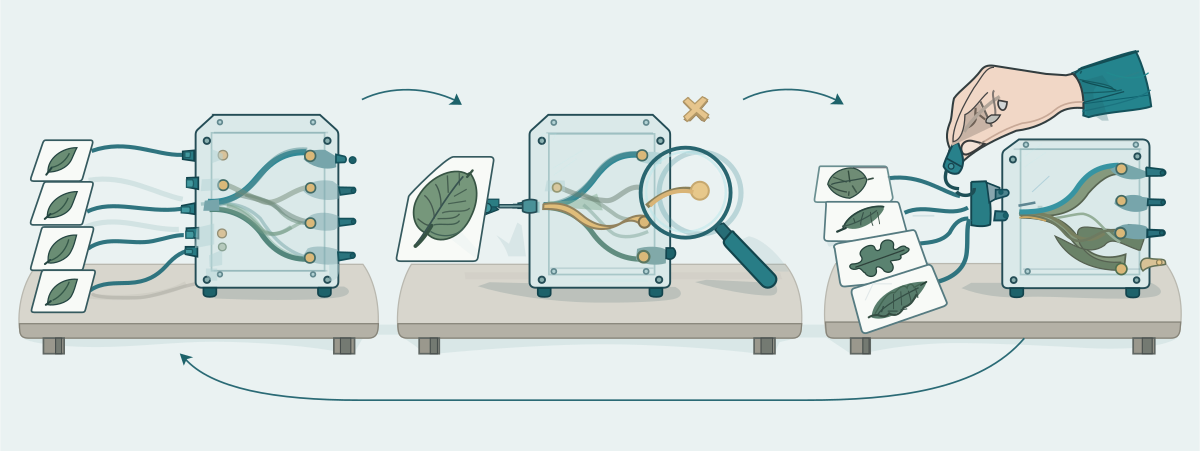
Within these labs, students become orchestrators and problem solvers. They choose data, decide on an approach and test the system they put together. They can safely break things: leave out examples, change an input or try something that doesn’t work. With guidance, they investigate unexpected results, question their assumptions and decide what to change. Their explanations and revisions form part of the work, making the process of solving the problem visible alongside the final result.
Our aim is for students to leave with the understanding to explain a solution, recognise where it falls short and make informed decisions about its use. We want them to carry that way of working into the next unfamiliar problem: examining the evidence, testing their ideas and using what they discover to move forward.
Get in touch
Let’s talk about AI in your school.
Tell us what you want students to explore, and we can discuss how ML4Schools could help.
Book a walkthrough